
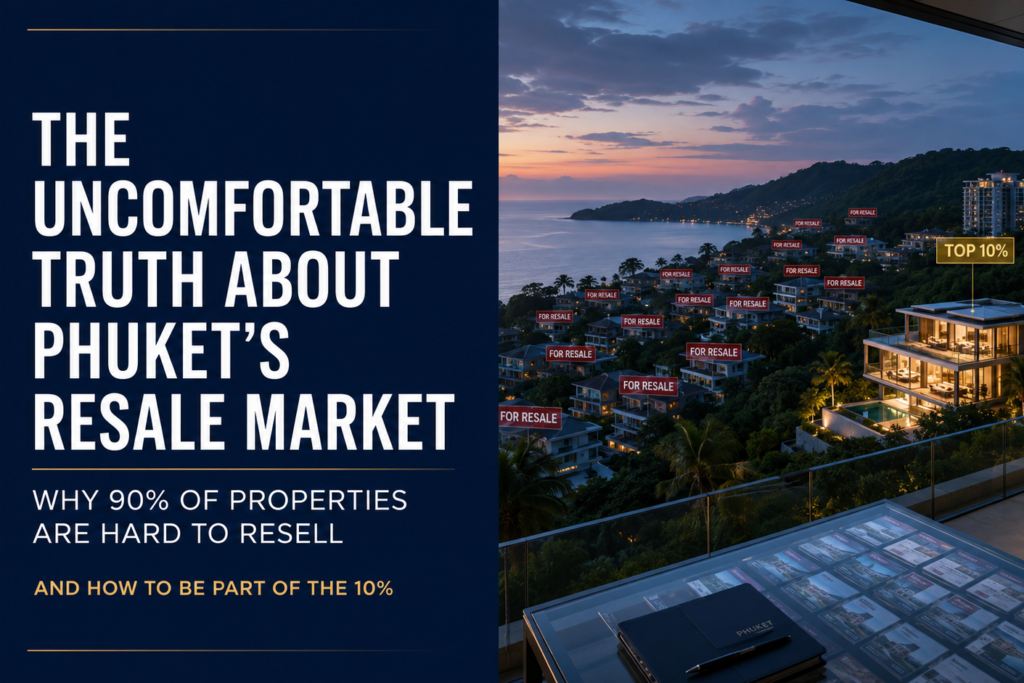
Why 90% of Properties Are Hard to Resell (and How to Be Part of the 10%)
Buying a property in Phuket is relatively straightforward. In a market flooded with stunning renderings, emotional videos, and promises of guaranteed returns, it is easy to be seduced by the idea of owning a piece of tropical paradise. However, the true “moment of truth” for a real estate investment does not occur at the signing of the deed, but when you decide to resell.
In 2026, the Phuket market has entered an unprecedented phase of maturity. While a few years ago speculation allowed almost anything to be resold, today we face a different reality: a “resale bubble” affecting properties that failed to anticipate new international standards. While transaction volumes remain high, a massive portion of the secondary market struggles to find buyers, remaining stuck on real estate portals for months, if not years.
The Paradigm Shift: From “Tropical Dream” to Lifestyle Investment
The profile of the buyer in Phuket has changed radically. We are no longer in the era of the impulsive tourist buying a holiday home. Today, the market is dominated by international investors—Russians, for instance, saw a +33% increase in condominium purchases in Q1 2026—and a global clientele seeking long-term solutions.
These new buyers are not just looking for a sea view; they demand efficiency, crystal-clear legality, and, above all, a construction quality that stands up to the standards of Dubai, Singapore, or Europe. The following table illustrates the divergence between what the market offered ten years ago and what “liquid” buyers demand today.
| Feature | 2016 Standard (Low Resalability) | 2026 Standard (High Resalability) |
| Accessibility | Widespread architectural barriers | Universal Design and total inclusivity |
| Energy | High consumption, poor insulation | EDGE Certifications, solar panels |
| Technology | Basic installations | Integrated Smart Home and automation |
| Target | Short-term tourists only | Families and long-term residents |
The Three Pillars of Liquidity: Why Many Homes Remain Unsold
Why does 90% of the secondary market struggle to find a new owner? The answer lies in three critical factors that many investors ignore at the time of initial purchase.
1. Premature Aging and the Absence of Inclusivity
The concept of Universal Design is no longer an option for a niche of people with disabilities. In a world where the global population with high purchasing power is aging, a villa with steep stairs, narrow bathrooms, and complicated access automatically becomes invisible to a large segment of potential buyers. Properties built ten years ago without inclusivity criteria are now considered “obsolete.” Investing in an accessible home means ensuring your asset is attractive to everyone: from young parents with strollers to European retirees choosing Phuket as their primary residence.
2. The Green Revolution and Management Costs
In 2026, energy efficiency has become a decisive financial factor. With rising electricity costs in Thailand, energy-hungry villas with poor thermal insulation have become an economic burden. Today’s buyers, especially those from mature markets, look for certified properties (such as the EDGE standard) that use sustainable materials and solar energy systems. A house that “costs too much to maintain” is a house that won’t sell.
3. Condominium Management and Asset Decay
A property in Phuket does not exist in a vacuum. Its resalability depends 50% on the quality of the Common Area Management. Many past projects suffer today from poor management that has led to the decay of common areas, pools, and security systems. A savvy buyer will analyze the minutes of condominium meetings and the status of the Sinking Fund even before looking at the furniture.
Liquidity Checklist: How to Buy Today to Sell Tomorrow
If you want to be part of the 10% of investors who manage to resell their property quickly and with a real capital gain, here are the fundamental criteria to verify before signing any contract:
The Golden Rule: Never buy a property based solely on a rendering or a promise of yield. Evaluate the property as if you had to resell it the next day.
1.Full Legal Compliance: Ensure the project complies with the new Royal Gazette regulations on building heights and green areas, especially for hillside properties.
2.Integrated Inclusivity: Verify that the project follows Universal Design principles. If there are no ramps, compliant elevators, and wide spaces, your future pool of buyers is halved.
3.International Construction Standards: Prefer developers who invest in environmental certifications and high-quality materials that withstand the tropical climate.
4.Local Secondary Market Analysis: Before buying “new,” look at what used properties in the same neighborhood are selling for (and if they are selling at all).
A Smart Investment is One You Can Exit
The Phuket real estate market still offers extraordinary opportunities, but it no longer forgives approximation. The difference between a “good deal” and a “stuck asset” lies in the ability to look beyond the marketing and understand the deep dynamics of future demand.
Don’t just buy a piece of land or an apartment; buy a real estate financial product that is liquid, inclusive, and sustainable. Only then can you turn your investment into a lasting success, ensuring a safe and profitable exit strategy when you decide it’s time for the next project.