
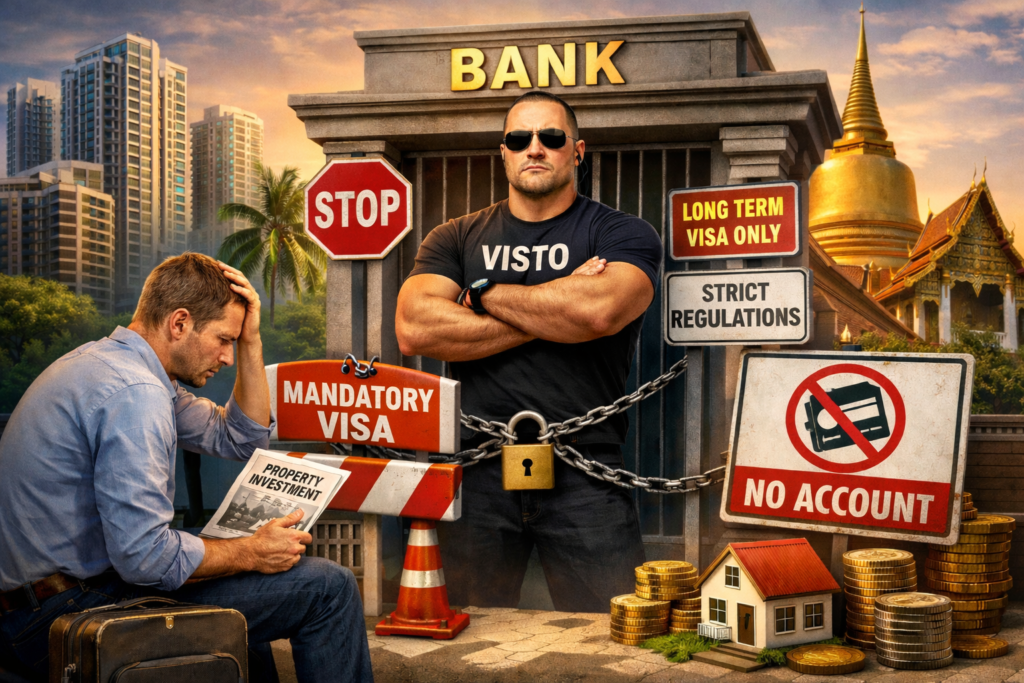
I have carefully read the recent regulations governing the opening of bank accounts for foreigners in Thailand. The conclusion is simple and, in my opinion, profoundly shortsighted: Thai banks only open their doors to those who possess a long-term visa (such as the 1-year visa), but they slam them shut in the faces of those who, while not living here, want to invest in the country by buying property.
This policy leaves me perplexed and raises a fundamental question: are banks here to foster the country’s development and facilitate those who bring in capital, or are they putting a spanner in the works of the economy, particularly the real estate sector and its developers?
I Invest, Therefore I Exist? Wrong.
The current logic seems to be: “You have a visa? You’re one of us. You don’t have a visa? Your 3, 5, or 10 million Baht are of no interest to us.”
But let’s think about this for a moment. The vast majority of foreign investors who buy a condominium in Bangkok, Phuket, or Pattaya do not live in Thailand full-time. They purchase a property as an investment, as a holiday home, or as a plan for a future retirement. Their contribution to the economy is immediate and tangible:
- They inject capital into the property market, supporting developers and the construction industry.
- They pay taxes and stamp duties on the transaction.
- They boost the local economy during their stays.
Yet, once the contract is signed, they are faced with a paradox: they have just invested a significant sum in Thailand, but they cannot open a simple bank account to manage condominium fees, receive rent (if they decide to put the property on the rental market), or pay bills efficiently, without having to bring foreign currency in cash or rely on expensive international transfers.
The Visa as the Bank’s “Bouncer”
The excuse? Security and anti-money laundering regulations. A perfectly valid argument, but used in a shortsighted way. If the priority is transparency, why not evaluate the person’s creditworthiness and actual investment?
The foreigner is asked to get a one-year visa that they will never use in full, forcing them through an expensive and complex bureaucratic process (health insurance, support letters, annual renewals) only to be able to open an account. It’s a solution that uses a sledgehammer to crack a nut, turning a potential investor into a “forced resident” on paper.
A Boomerang for the Thai Economy
This policy risks becoming a dangerous boomerang.
- For Developers: Selling an apartment to a foreigner is becoming increasingly complex. It’s no longer enough to showcase the project’s beauty and the potential return on investment. Now, one must also find creative (and sometimes borderline) solutions to allow the buyer to manage their local finances, or risk losing the sale.
- For the Sector: It creates a disincentive for foreign investment. Why would an investor choose Thailand if they then find themselves hindered in the day-to-day management of their asset? Competing countries like Malaysia or Vietnam offer much more streamlined solutions for foreign investors.
- For the Banks Themselves: They are depriving themselves of a potential market segment made up of wealthy clients with capital to manage, preferring a rigid bureaucratic approach over a business-oriented one.
The Request: Common Sense and Pragmatism
We are not asking for privileges; we are asking for pragmatism.
We ask that Thai banks distinguish between a tourist with a backpack and an investor who has just put millions of Baht on the table to buy a property in the country. The property, registered in the foreigner’s name, should be the best guarantee, the irrefutable proof of a concrete link with Thailand.
The requirement should not be a visa that isn’t used, but the deed of ownership. A basic current account, perhaps with limited operations, linked to the management of the property, should be an automatic right for those who invest.
The current policy seems to forget a fundamental truth: an investor who cannot manage their investment will, sooner or later, stop investing. And that is a loss the Thai economy cannot afford.