
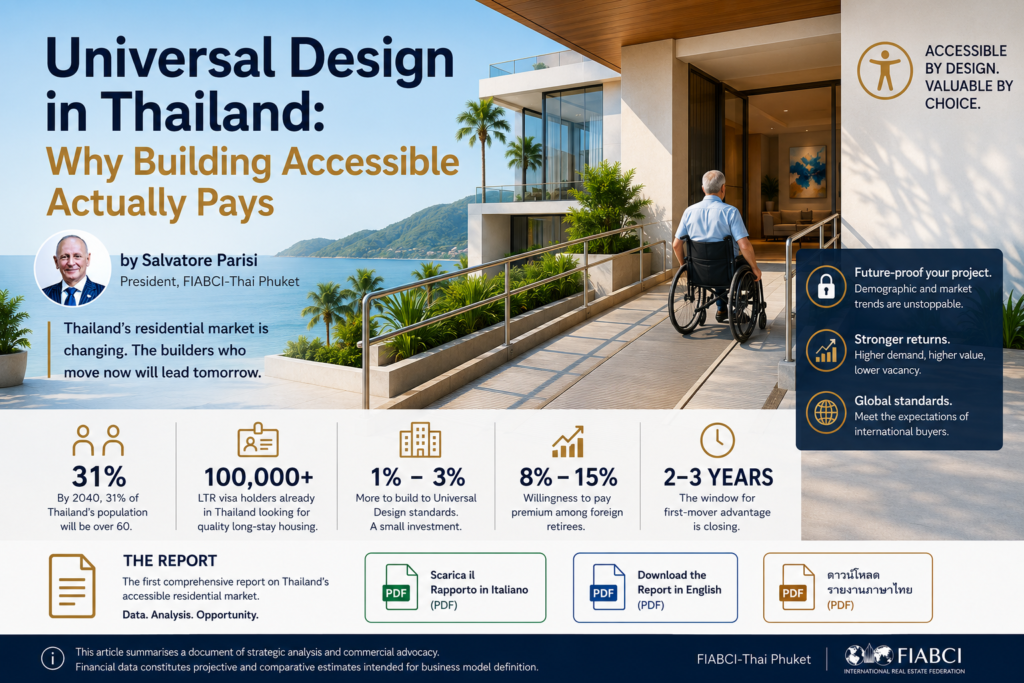
by Salvatore Parisi, President, FIABCI-Thai Phuket
Universal Design in Thailand: Why Building Accessible Actually Pays Picture this. You decide to make Thailand your home for the years ahead. You have the budget, the LTR visa, and the perfect condo picked out. Then you discover the bathroom won’t fit a wheelchair, the doors are too narrow, and there are three steps in front of the entrance.
This isn’t a rare edge case. It’s the standard across almost all of Thailand’s private residential market.
The Problem Nobody Talks About
Thai law requires accessibility only in public buildings. Private condominiums — where hundreds of thousands of foreign residents live, invest, and retire — carry no legal obligation to provide accessible design.
Italy solved this problem 35 years ago: Law 13/1989 and Ministerial Decree 236/89 require accessible design in all new private residential construction nationwide. The same principle applies, with variations, in the US and Singapore. Thailand has not caught up.
But the real question isn’t regulatory. It’s commercial: whoever builds accessible first will hold an advantage that competitors will take years to match.
The Numbers That Matter
By 2040, 31% of Thailand’s population will be over 60. Today, over 100,000 LTR visa holders — foreign retirees and professionals with guaranteed income — are actively looking for quality long-stay housing. Almost none of them find what they need.
We analysed the real costs of accessible construction in Thailand, verified with architecture firms and contractors active in Phuket in 2025–2026. The result is striking: building a premium condominium to Universal Design standards costs between 1% and 3% more than a standard build — and the full project-level cost (including specialist design fees, site supervision, and UD-specific marketing) runs between THB 3M and THB 8M on a 50-unit project.
On a project with THB 560M in standard revenues, the break-even price premium is just 1–1.5%. A premium that international buyers are more than willing to pay — estimates point to 8–15% WTP in the foreign retiree segment — but that they can’t pay today because the product simply doesn’t exist.
The Window Is Closing
Major developers like Sansiri, through their joint venture with Japan’s Mitsui Fudosan, are moving toward Universal Design standards. When they arrive — likely within two years in Bangkok, within three in Phuket — the first-mover advantage will be gone.
Those who move now have a real window. Those who wait will be chasing.
The Report
We took a deep look at Thailand’s accessible residential market: locally verified cost data, a corrected financial model, an honest competitive analysis. Including the limits of what we don’t yet know, and the independent research needed to bring this work to investment-grade level.
The result is the first comprehensive report on this topic, available in three languages. Download it below.
This article summarises a document of strategic analysis and commercial advocacy. Financial data constitutes projective and comparative estimates intended for business model definition.
📄 [Scarica il Rapporto in Italiano (PDF)] 📄 [Download the Report in English (PDF)] 📄 [ดาวน์โหลดรายงานภาษาไทย (PDF)]