
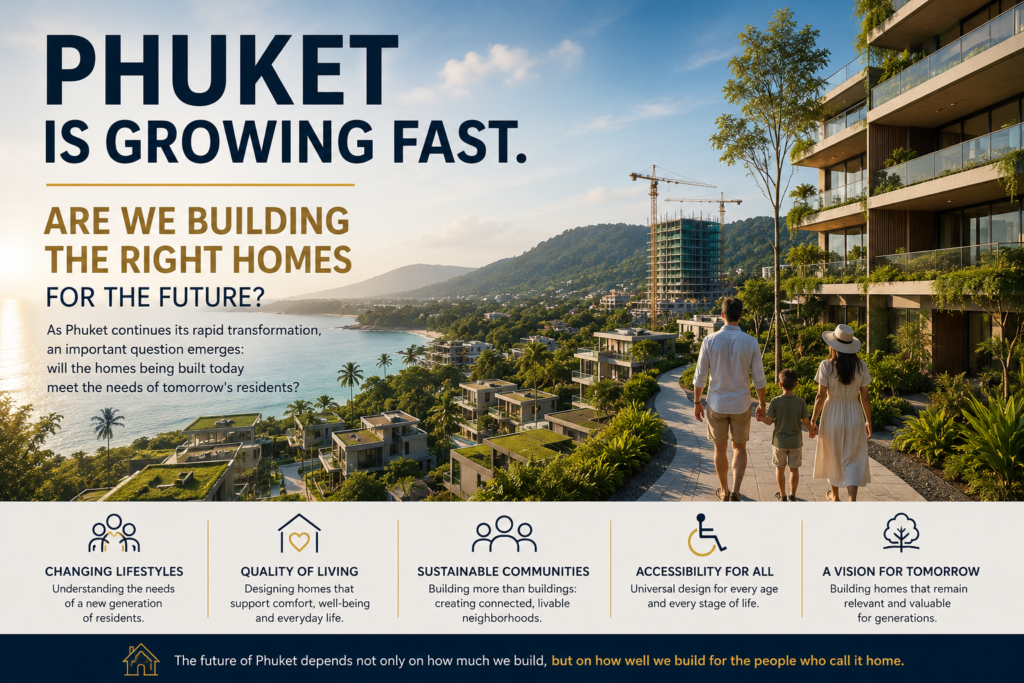
As Phuket continues its rapid transformation, an important question emerges: will the homes being built today meet the needs of tomorrow’s residents?
Over the past decade, Phuket has experienced one of the most significant real estate transformations in its history.
New condominium developments, luxury villas, branded residences, mixed-use communities and large-scale residential projects are reshaping the island at a pace that would have been difficult to imagine just a few years ago.
From Bang Tao and Cherngtalay to Rawai, Nai Harn, Mai Khao and Ko Kaew, construction activity continues across the island. Cranes have become part of the landscape, and announcements of new developments appear almost every month.
This growth is undoubtedly a positive sign. The ability to attract international investment confirms Phuket’s increasing importance within the Asian real estate market and reinforces its position as one of the most desirable destinations for investors, retirees, entrepreneurs and families from around the world.
However, behind this impressive growth lies an important question that deserves greater attention.
Are we building the right homes for Phuket’s future?
This question is not about the quality of individual projects or the capabilities of developers. Instead, it concerns something much broader: understanding how the needs of people choosing Phuket as a place to live, invest and build their future are evolving.
A Market Originally Driven by Investment
For many years, Phuket’s real estate market was largely driven by investment demand.
International buyers were primarily looking for holiday homes, rental properties or investments with strong capital appreciation potential.
As a result, developers designed products that matched those market expectations.
Compact units, high-density developments, extensive shared facilities, hotel-style management services and strong rental return projections became key selling points across many projects.
This model played a crucial role in Phuket’s success and helped establish the island as one of Southeast Asia’s most dynamic property markets.
Today, however, the profile of the buyer is changing.
More People Are Choosing Phuket as Home
While many foreign buyers once viewed Phuket primarily as a holiday destination, an increasing number now see it as a place to live full-time or for extended periods.
International families, entrepreneurs, remote workers, active retirees and long-term residents represent a growing segment of demand.
These buyers are not focused solely on investment returns.
They are focused on quality of life.
They evaluate factors such as international schools, healthcare services, infrastructure, mobility, safety and the overall livability of a community.
For those who choose Phuket as their home, property is no longer simply a financial asset.
It becomes an essential part of their daily lives and future plans.
Will Today’s Homes Meet Tomorrow’s Needs?
This may be one of the most important questions facing the real estate industry.
Many of the projects launched in recent years have been designed to satisfy the needs of today’s market.
But the world is changing rapidly.
Work patterns are evolving.
Family structures are changing.
Life expectancy continues to increase.
More people are spending significant portions of their day at home, balancing work, family and leisure within the same environment.
In this context, characteristics once considered secondary may become increasingly important.
Flexibility of space, functionality, comfort and the ability of a home to adapt to different stages of life may become key drivers of future demand.
The Question of Living Space
One area worthy of reflection is the size of residential units.
Many modern condominium projects offer apartments ranging between 28 and 35 square metres.
These products may be perfectly suitable for short-term stays or rental-focused investments.
However, are they always the ideal solution for long-term living?
A couple working remotely, a growing family or an individual planning to spend retirement in Phuket may have very different requirements from those of a tourist or short-term investor.
The quality of a home is not determined solely by its location or amenities.
It is also defined by its ability to support the changing needs of those who live in it.
A Changing Demographic Landscape
Thailand, like many countries around the world, is experiencing significant demographic change.
An ageing population will be one of the defining realities of the coming decades.
The same trend applies to many international residents who choose Phuket as a destination for retirement or long-term living.
This shift should encourage the real estate sector to think more carefully about how homes are designed and developed.
The challenge is not simply to meet today’s expectations.
It is to anticipate how people will live ten, twenty or even thirty years from now.
Beyond Construction: Building Quality of Life
The success of a destination cannot be measured solely by the number of buildings completed.
It must also be measured by the quality of life it offers.
The most successful cities and residential destinations in the world invest not only in property development but also in infrastructure, public spaces, mobility, healthcare, education and community wellbeing.
Phuket possesses many unique advantages.
Its natural beauty, international appeal, established tourism sector and expanding range of world-class services continue to attract people from around the globe.
The challenge for the future is ensuring that growth remains balanced and sustainable.
The Growing Importance of Accessibility and Universal Design
Another topic that is becoming increasingly relevant internationally is accessibility.
For many years, accessibility was viewed primarily as an issue affecting people with disabilities.
Today, the concept of Universal Design is understood much more broadly.
An accessible home is easier to use for families with young children.
It is more practical for older residents.
It is more comfortable for people recovering from temporary injuries.
Ultimately, it creates a better living environment for everyone.
In many mature property markets, Universal Design principles are becoming an integral part of modern development.
As Phuket continues to evolve, incorporating these concepts could become an important factor in enhancing both quality of life and long-term property value.
Looking Beyond the Next Property Cycle
Real estate markets naturally move through periods of growth, adjustment and transformation.
The most successful developers and industry leaders are not necessarily those who react best to current trends.
They are often those who anticipate future needs before they become obvious.
Today, Phuket is in a privileged position.
The island has the opportunity not only to grow, but to grow wisely.
It can continue attracting investment while simultaneously improving the quality of life for residents.
It can build not only properties, but thriving communities.
It can design not only for today’s market, but for future generations.
Phuket’s real estate growth represents an extraordinary opportunity.
International investment remains strong, demand continues to evolve and the island’s long-term potential remains highly attractive.
Yet as new projects continue to emerge across the island, this is also the right moment for reflection.
The greatest challenge is not simply to build more.
It is to build better.
It is to understand how people’s needs are changing and to create homes capable of maintaining their value, functionality and relevance over time.
Because the future success of Phuket’s property market will not be determined solely by the number of buildings completed.
It will be determined by our ability to create places where people genuinely want to live — today, tomorrow and for generations to come.