
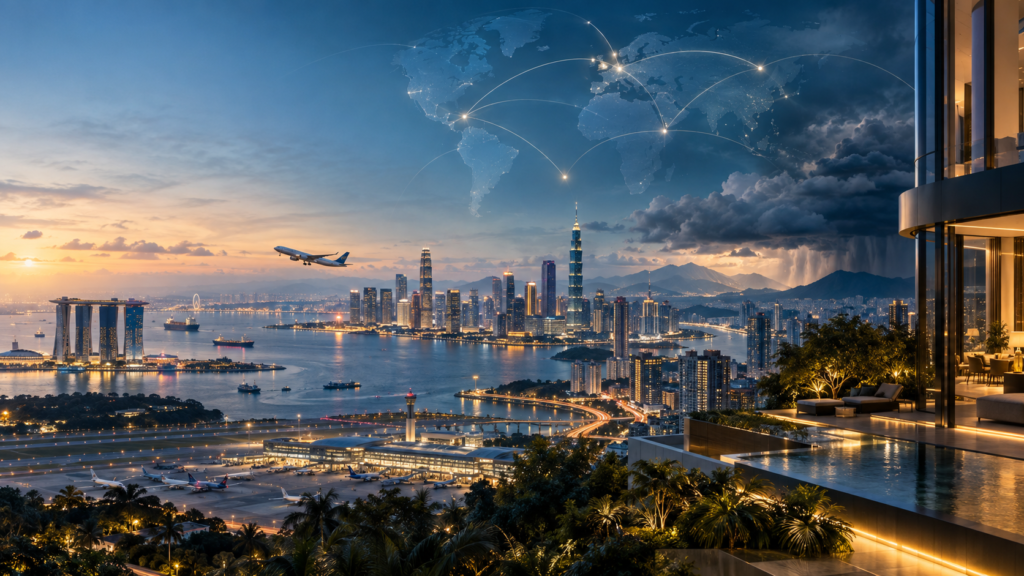
The world is going through a period of rapid transformation. Geopolitical tensions, conflicts, new trade policies, rising costs and extreme weather events are changing the decisions made by governments, businesses, consumers and investors.
The effects involve several interconnected sectors, including international trade, transportation, real estate, tourism and hospitality. Understanding this new landscape therefore requires more than observing individual events: we must consider how these developments collectively influence confidence, demand and investment strategies.
An Increasingly Interconnected World
Trade policies have become a growing source of uncertainty. Tariffs, sanctions and restrictions are increasingly being used as instruments of political and economic pressure, affecting business costs, supply chains and investment decisions.
At the same time, conflicts in different parts of the world produce consequences that extend beyond the areas directly involved. Energy prices, air routes, transportation costs and international confidence can also be affected in geographically distant countries.
Climate-related risks add another layer of complexity. Floods, storms and heatwaves can no longer be viewed solely as exceptional events. They have become factors that businesses, developers and investors must include in their operational and financial assessments.
Taken together, these developments suggest that the coming years may continue to be characterised by significant uncertainty and a more fragmented international system.
People’s Priorities Are Changing
People are responding to this situation by becoming more careful and selective. Price remains important, particularly because of rising transportation and accommodation costs, but it is now only one of several factors being considered.
Geopolitical concerns, confidence in the economy, travel procedures and service reliability are becoming increasingly important. Climate events, overcrowding in certain destinations, staff shortages and transportation delays can also influence people’s choices.
Demand is therefore becoming more informed and selective. People are seeking a balance between affordability, safety, accessibility and quality. Destinations and businesses capable of providing stability and reliable services may gain an advantage over those competing primarily on price.
New Dynamics for Tourism and Hospitality
Global travel continues to grow, although at a more moderate pace and with significant differences between regions.
When political tensions intensify, confidence and hotel demand can decline rapidly. However, this does not necessarily mean that people stop travelling. More often, visitor flows shift towards destinations perceived as safer, closer or easier to reach.
Some European and Asian markets are benefiting from this change. For many consumers, regional and medium-distance travel is also becoming more attractive than long-haul journeys.
Destinations and hospitality businesses must therefore maintain a diversified customer base. Excessive dependence on a single country or geographical market can create vulnerability when economic conditions, travel regulations or political circumstances change.
A More Cautious Approach to Investment
The hospitality and real estate sectors continue to attract capital, but investors are applying stricter criteria before making new commitments.
The higher cost of capital makes new projects more expensive to finance. Currency fluctuations can increase the price of imported materials and construction, while economic and political uncertainty may slow negotiations and decision-making.
Location and potential returns remain important, but they are now considered alongside political stability, infrastructure quality, market resilience and demand diversification.
Capital is not necessarily leaving these sectors. Instead, it is moving towards markets where risks appear manageable and long-term demand is supported by multiple sources.
When Safety Becomes a Source of Value
Safety is no longer only a social or institutional matter. It has become an economic factor capable of influencing demand, a destination’s reputation and the value of an investment.
A significant proportion of international travellers report having changed, postponed or cancelled their plans because of concerns about the safety of their intended destination.
The same principle is becoming increasingly relevant to investment decisions. Stability, infrastructure quality, service reliability and the ability to manage emergencies all contribute to the overall perception of a market.
Beauty, affordability and growth potential remain important, but they may no longer be sufficient on their own. In an uncertain environment, confidence can become one of the most valuable qualities a destination can offer.
A Landscape to Understand, Not Fear
The new global environment does not signal the end of travel, development or investment. Instead, it is changing the criteria used to evaluate opportunities.
Demand continues to exist, and capital continues to seek attractive markets. Both, however, are moving more carefully towards places capable of offering stability, diversification, resilience and adaptability.
The best-prepared destinations and businesses will not necessarily be those offering the lowest prices or the fastest growth. They will be those capable of inspiring confidence and responding effectively to an increasingly complex international landscape.
This article was developed using analyses and indicators published by international organisations active in the fields of economics, tourism and hospitality.